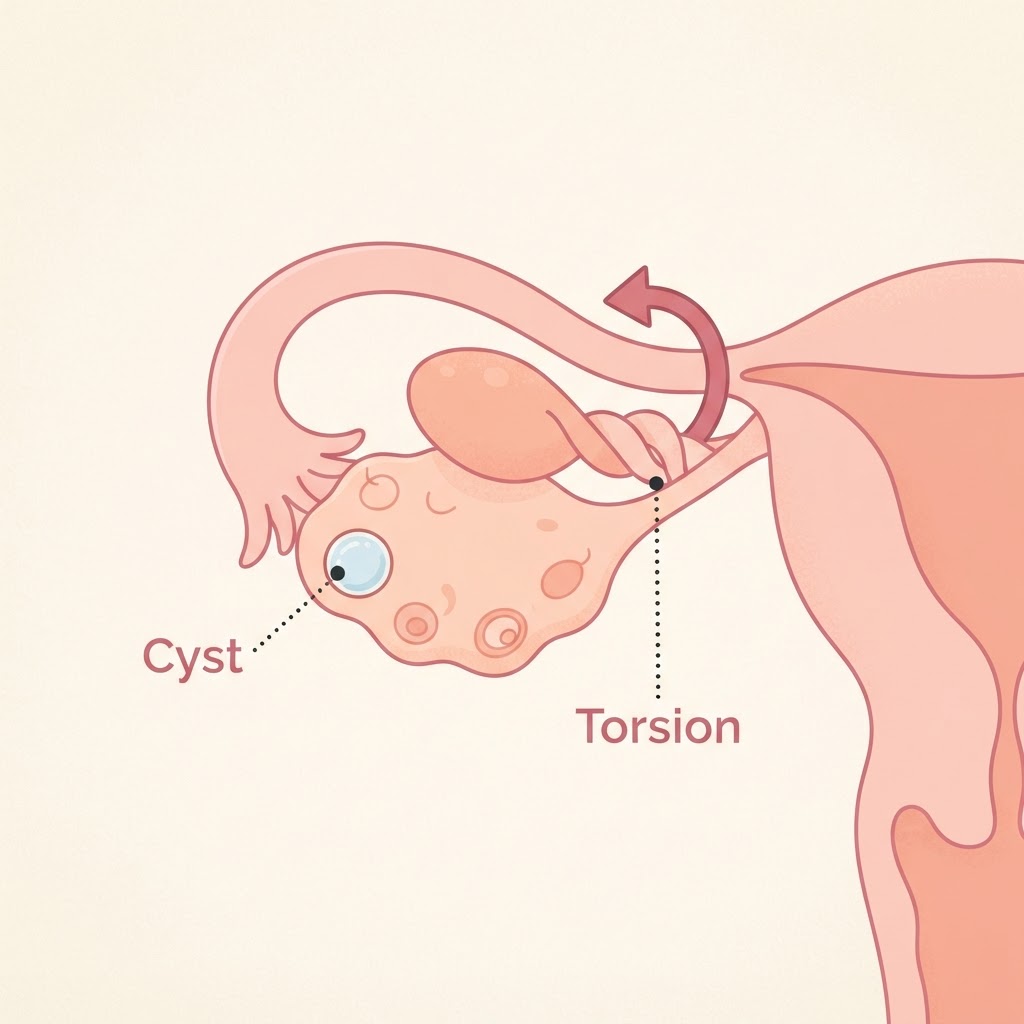
Trust the Signal: Ovarian Cysts and Torsion
You were probably never told that your ovary could twist.
That somewhere between the cramps and the cycles you've been managing since your early teens, there is a small, suspended organ held in place by a ligament no wider than a stem — and that under the wrong conditions, it can rotate on that stem and cut off its own blood supply.
It's called ovarian torsion. It is a medical emergency. And almost no one learns its name until they're lying in A&E, being asked to rate their pain on a scale of one to ten.
First: what a cyst actually is
An ovarian cyst is a small, fluid-filled sac that forms on or inside an ovary. Most are functional — a normal part of your cycle, the leftover shell of an egg that was released, or wasn't.
They come and go quietly. Many people have them and never know.
This is the part that gets lost in the fear: most cysts are not dangerous. They are common, they are usually silent, and they often disappear on their own within a few weeks. Your body, for the most part, handles this without you.
When quiet becomes urgent
The danger arrives when a cyst grows large enough to make the ovary top-heavy — or when it fills with blood or fluid in a way that changes the ovary's weight.
Then, with the wrong movement, the ovary can twist on its ligament. That twist kinks the blood vessels. Blood can flow in but not out. The tissue swells. Without blood, the ovary can die within hours.
This is torsion. It is rare. It is also one of the most under-recognised emergencies in women's health — because its earliest symptom, sudden and severe pelvic pain, is the same symptom that has been dismissed, minimised, and psychologised in women and girls for generations.
The alarm you were taught to turn down
Here is the part that matters most. The classic signs of torsion are:
- Sudden, severe lower abdominal or pelvic pain — often sharp, often one-sided, often unlike anything you've felt before
- Nausea and vomiting that come with the pain, not after it
- Pain that may radiate to your back, side, or groin
- A feeling that something is genuinely wrong — a sense of alarm that doesn't match "just a bad period"
That last one is not a throwaway. Your body has an alarm system. It is fast, it is ancient, and it is usually right.
The tragedy is how often that alarm has been trained out of us — until we no longer trust it when it finally screams.
What to do
If you experience sudden, severe, one-sided pelvic pain with nausea or vomiting — especially pain that comes on fast and doesn't settle — go to emergency care.
Don't wait to see if it passes. Don't book a routine appointment.
Torsion is time-sensitive. The ovary can sometimes be saved if treated quickly, and the window is measured in hours, not days.
You are not overreacting. You are not wasting anyone's time. You are responding to a real signal from a real organ. That is exactly what the signal is for.
Knowing is a form of safety
Most cysts will never hurt you. Most cycles will come and go without incident. But knowing the difference between ordinary and urgent is not anxiety — it's preparation. It's the quiet confidence that comes from understanding your own body well enough to act on its behalf.
You don't need to live in fear of your ovaries. You just need to know that when they speak loudly, they mean it.
And when they do, you are allowed to take them seriously — even if someone once taught you not to.
This article is educational, not medical advice. If you are in sudden severe pain right now, seek emergency care.

